
Before I started making jewelry and taking classes, I didn’t understand what a “good” metal was (spoiler: there’s no such thing!).
After talking to so many different people at markets and chatting with friends, I realized most people are confused too! There’s an unexpected level of science involved when understanding metals and how they interact with your body. To make matters worse, brands aren’t always straightforward about what their jewelry is made of. Well, I’m here to break it down and make it simple. No longer will you be uninformed on quality, durability, and price when buying jewelry!
First, let’s break down the jewelry categories. (Keep in mind that these categories are broad and there are ranges in between that some brands fall under, like ours!)
Fashion Jewelry
The most budget-friendly pieces you’ll find! Fashion jewelry can be made to look expensive, but it’s always made of non-precious materials (except for real gold or rhodium plating).
On the lower end, you’ll see plastic used for fake gems/pearls and alloys like zinc used for metals. Brass, more durable than zinc alloy, is also used as a base metal and typically plated. Depending on the plating process used on brass and zinc alloy, gold/silver color can fade quickly and pieces can tarnish, leaving your skin green and jewelry no longer sparkling.
Brass and zinc alloy may not be allergy-friendly because they contain nickel or other metals people are sensitive to.
Friendly Folk falls into the “fashion jewelry” category, but on the higher end. We use stainless steel for our jewelry, a much more durable and hypoallergenic option (plus all the steel we use is recycled!). We use a special 14k gold & rhodium plating process called PVD (Physical Vapor Deposition) which is also used in things that require high durability, such as in the automotive industry or your bathroom hardware! This means your plated pieces from us stay gold (or silver) and shiny for years, even when exposed to water and sweat, vs. other plated metals that can wear off in just a couple wears and corrode when exposed to water and air. We care deeply about combating fast fashion jewelry that’s only meant to be worn a couple times then thrown away.
Why don’t other brands use more stainless steel then?
I also wondered why until I learned how to design for jewelry. It comes down to this: Certain metals are best for certain designs.
Stainless steel is a difficult metal to work with. It’s not very malleable like brass, so it’s not good for intricate, detailed designs. It also has a high melting point which makes delicate soldering very difficult (attaching teeny tiny pieces to each other using heat). Stainless steel is best for chunkier, simpler designs, which doesn’t always suit other brand aesthetics. It’s also slightly heavier than other metals like zinc alloy, but it won’t tarnish like zinc alloy. Plated brass, which is most frequently used in fashion jewelry, is best for detailed designs, but it also tarnishes, fades, and turns your skin green over time. As you can see, every metal has tradeoffs.
These are all behind-the-scenes things you, the jewelry shopper, don’t necessarily have to worry about. But as a jewelry designer, I’m always thinking about what metal to use and how to best use it. I believe a piece of affordable jewelry that’s more durable and has greater longevity (using stainless steel) is more worth my money, plus I’m not sacrificing looking cute or luxurious. It’s all in the challenge of figuring out how to design well within limitations!
Fun fact: Some luxury brands like Chanel sell their own category of fashion/costume jewelry, using the exact same materials as other fashion jewelry brands, but at a much higher price point (closer to demi-fine or fine jewelry prices). You’re paying for the brand name and perceived value! Just because a piece of jewelry is expensive doesn’t mean it’s made with the most valuable or long-lasting materials.
TLDR: Brass & Zinc Alloy are common base metals for fashion jewelry for being lightweight & great at intricate designs, but they lose color, tarnish, aren’t hypoallergenic, and will turn your skin green as the plating wears off over time. Stainless steel is also used as a base metal (we use this!), is hypoallergenic, won’t tarnish or corrode, is extremely durable, but has design limitations and feels a little heavier.
Demi-Fine Jewelry
Demi-fine jewelry is a more accessible category of jewelry compared to fine jewelry, but it can be significantly more expensive than fashion jewelry. This type of jewelry is considered a “bridge” category between fashion and fine jewelry.
Demi-fine jewelry uses semi-precious materials and plating techniques: 925 sterling silver, gold-filled, or gold vermeil. (The prices of silver have been crazy this year and have skyrocketed from $30 a troy oz to over $100 a troy oz at one point, which makes this category more ambiguous lately!) Semi-precious gems and stones are used in this category (like amethyst, garnet, peridot, etc.) instead of plastic & glass (fashion) or precious gems like diamonds, emeralds, and rubies (fine).
Gold-filled
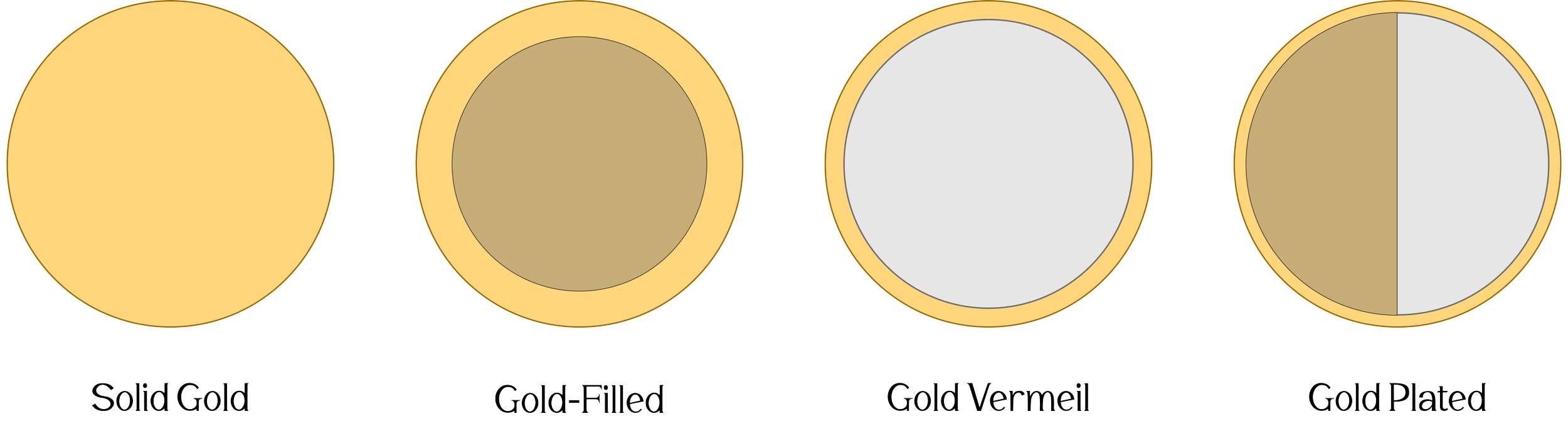
Gold-filled jewelry uses brass as a base metal. What makes this different from fashion jewelry’s plated brass? Gold-filled jewelry uses a thicker, higher percentage of real 12k or 14k gold that bonds to the brass underneath. This helps make the piece more allergy-friendly and tarnish-resistant, creating a thicker and more durable wall over the brass so it doesn’t interact with your skin. Gold-plated brass in fashion jewelry uses a much thinner layer of gold which is less permanently bonded to the brass core.
Gold Vermeil
Gold Vermeil uses sterling silver as a base metal, which is then plated in a layer of real gold. While gold vermeil uses a more precious base metal than gold-filled, gold vermeil uses a thinner layer of plated gold and therefore contains a smaller percentage of gold. Gold vermeil jewelry is less durable than gold-filled but has a more luxurious look.
Sterling Silver
Sterling Silver alone is a semi-precious metal (though with silver prices being so high in 2026, I question this label). Sterling silver is the metal we use in jewelry school to practice hand fabrication with! Sterling silver is not pure silver—pure silver is called fine silver. The reason fine silver isn’t used much in jewelry is because it’s too soft. Sterling silver combines silver with other metals to strengthen it and make it suitable for daily wear.
Sterling silver does tarnish, but it’s a very different metal from tarnishing metals like brass or zinc alloy. While brass or zinc alloy will turn your skin green and not be as friendly to sensitive skin, sterling silver will not turn your skin green.
A weird thing about sterling silver is that the more you wear it, the less it tarnishes. The oils in our skin prevent it from tarnishing—weird, right?
Sterling silver is also easy to clean with a polishing cloth if it turns dark. Since there’s no plating on top of plain sterling silver (except for some brands that incorporate anti-tarnish finishes), the abrasives in the polishing cloth do not damage the piece. The only thing to be mindful of is removing an intentional patina with a polishing cloth—areas where the silver is purposefully darkened through manual oxidation. Polishing cloths will remove this patina if you over-polish a piece!
An important note! Any jewelry that is plated, gold-filled, or vermeil should not be used with a polishing cloth. Polishing cloths are abrasive, often with polishing compound embedded in them. Abrasives remove layers of metal (think of rubbing sandpaper on wood, but at a much smaller scale!), which removes the plating on your jewelry.
Fine Jewelry
Finally, the heirloom-quality investment pieces that are fine jewelry. Fine jewelry is the most expensive but most valuable category. Made of solid gold or platinum and precious gems, pieces often start at $500. And yes, lab-grown gems are fine jewelry—they are chemically identical to the real thing!
Fine jewelry made of solid gold is not plated; it is gold all the way through. Solid gold is a deceptive name though, and here’s why:
Just like silver, pure gold alone would be too soft to wear as jewelry. To make gold stronger, it is alloyed with other metals like zinc, copper, nickel, and silver (this is why some people are allergic to gold!). These metals and their ratio also change the color of the gold. Did you know rose gold is that color because it contains a higher ratio of copper?
You may have noticed solid gold pieces marked with different karats: 10k, 12k, 14k, 18k, and 24k. These numbers identify the percentage, or purity, of gold in the piece, measured in karats (10k the lowest, 24k the highest). The rest of the composition of the “solid gold” is other metals. The amount of gold a piece of jewelry contains changes not only the monetary value but the gold color of the jewelry, from a pale hue to a deep, saturated gold.
An emerging trend I’ve seen brands incorporating is 10k gold pieces, providing a more accessible entry point into fine jewelry ownership. 10k gold contains 10 parts of gold and 14 parts of other metals. This smaller ratio of gold gives pieces a paler yellow color.
I wish I could own an entire collection of fine jewelry. It sparkles the most, allows for the most intricate designs, and is just simply beautiful. But sadly, I and most others do not have thousands to hundreds of thousands of dollars to exchange for beautiful things. :( This is why fashion jewelry and demi-fine jewelry are well-loved categories. Feeling confident and cute in the accessories we wear should be an option for everyone, and with brands like Friendly Folk you don’t have to sacrifice quality for affordability.
Beyond The Material
There’s more to consider beyond the value of a material. The creativity, exclusivity, or handmade aspect of a piece can change jewelry’s value. A completely handmade piece of jewelry made entirely in brass can go for hundreds of dollars, whereas a manufactured piece can be made of the same materials and cost substantially less. Every jewelry brand positions themselves in a different way. This isn’t good or bad, it’s just different business models.
What to Avoid
Have you ever come across an adorable piece of jewelry and went to see what it was made of, only for the description to look like this?
Materials: Gold tone. Metal.
We have! And this, to me, lacks transparency and quickly loses my faith in a brand’s product. When a seller won’t tell you what their piece is made of, such as the base metal or percentage of precious metals, you can’t make informed purchases. I don’t know if my skin will be sensitive to the jewelry, if it will tarnish and if I can polish it, if it will be durable, etc. I typically avoid buying jewelry without this information.
As you can see there’s not really a “good” or “bad” metal, just the question of what you value in the piece of jewelry you’re looking for. Are you looking for an investment? Or do you want to accessorize without the worry of losing an incredibly expensive piece? What metals can your skin tolerate? Are you okay with turning a little green to look cute, or would you prefer not to? What can you afford? Is longevity important to you?
For us at Friendly Folk, we value longevity, adorable & unique designs, comfort, and quality, but all at an affordable price.
I hope this article has helped you understand more about metals so you can shop with confidence! :)